Interest can take a large share of a payment. New spending and a shrinking minimum can slow repayment further.
A $150 payment can feel substantial coming out of your checking account and look surprisingly small on the next card statement. If $100 went toward interest, only $50 was left to reduce what you owed, before any new purchases or fees.

First, check which balance you’re looking at. Your statement balance is a snapshot from the end of a billing cycle; your current balance reflects later activity too. If you’ve paid the statement in full but bought groceries since then, a new balance in the app doesn’t by itself mean old debt is hanging around. The examples below concern debt you’re carrying from month to month.
The share interest takes
Start with a hypothetical $5,000 balance at a 24% annual percentage rate, or APR. To keep the arithmetic in plain view, we’ll approximate that as 2% a month on the opening balance. That’s $100 in interest. Pay $150, with no new charges or fees, and the balance falls by just $50, to $4,950. Two-thirds of the payment went to the cost of borrowing.
A real statement won’t necessarily match that shortcut. Many issuers calculate interest using daily balances, so the dates of your payments and purchases matter. For your own account, start with the interest charge printed on the statement rather than trying to reproduce it from the headline APR.
When new charges refill the balance
Suppose a statement shows a $5,000 starting balance, $100 in interest, $75 in purchases and a $150 payment. The tally is:
$5,000 + $100 + $75 − $150 = $5,025
You paid $150 and finished the cycle owing $25 more. Here, the $100 interest charge is given, not calculated from the timing of those purchases. A fee would push the balance higher; a refund or credit would pull it down.
Carrying a balance can also affect the grace period that normally lets eligible purchases avoid interest. New spending may start accruing interest as well. If those charges are groceries or gas because the paycheck runs out before the month does, a higher payment won’t fix the gap between income and essentials.

The shrinking minimum
This is the part I’d watch most closely, because it can show up as welcome relief: a smaller payment due.
Take an invented minimum-payment rule. Each month you owe the interest plus 1% of the opening balance, or $35 if that sum is lower. On our $5,000 balance, the first minimum is $150. Once the balance drops to $4,950, the next one is $148.50. This comparison assumes a steady APR and no new purchases or fees.
Until the $35 floor takes over, the rule pays down only about 1% of the debt each month. One percent of a smaller balance is a smaller dent. Follow that minimum all the way, and this model takes 16 years and 9 months to clear the $5,000, with about $8,442 in interest.
Now keep paying $150 instead. Both paths start with the same payment, but the fixed payment leaves more for the debt as interest falls. This path finishes in 4 years and 8 months, with about $3,322 in interest. The last payment is smaller because only $72.17 remains to be paid that month. At that point, the minimum-only path still owes about $2,848.
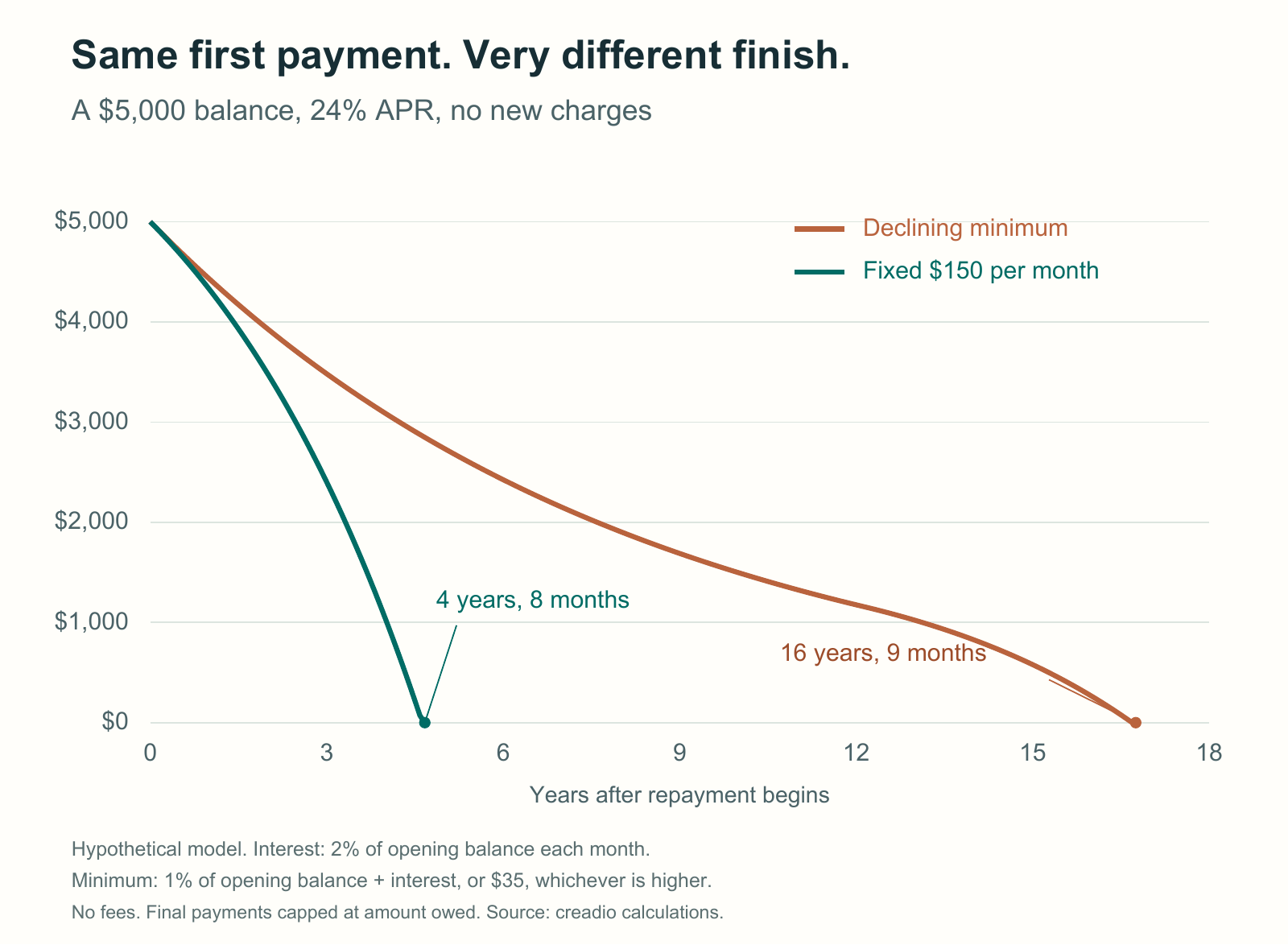
Holding a payment steady is useful only if you can afford it after essentials and it meets the actual minimum on each statement. Your issuer’s formula may be different, and fees, new charges or a changed APR can raise the amount required. Check that number even if your payment is automatic.
Look for the repayment comparison on your statement. Where shown, it estimates how long minimum payments would take and may give a monthly amount for paying off the statement balance in 36 months. That three-year amount is a planning figure; only the minimum is required. The estimates assume no new charges; they won’t describe your path if you keep adding purchases.
If the minimum is out of reach
If the minimum doesn’t fit, contact the card company promptly. Explain what you can pay, why you’re struggling and how long you expect the problem to last. Some issuers may work with you; a particular payment change isn’t guaranteed. Ask what assistance is available and what its terms would be.
If you want help working through the whole budget, a nonprofit credit counselor may also be an option. Nonprofit doesn’t automatically mean free, so ask about charges and services before signing up.

Reading your statements
Before your next payment, put the last two statements side by side. Compare the two statement balances, then find the payments, interest, new purchases and any fees or credits that explain the change. Write this month’s minimum beside the payment you can afford. Those are the numbers to have in front of you when you choose a payment or call for help.
Sources: CFPB consumer pages, last reviewed: card interest (January 22, 2024), repayment disclosures (January 22, 2024), payment difficulties (September 2, 2026) and daily periodic rates (September 23, 2024); Chase’s explanation of statement and current balances (undated). Links are in the text. Sources checked October 21, 2026.
The chart uses a simplified monthly model. Actual card calculations can use daily balances, different minimum formulas and changing rates. The examples are for general education, not personal financial advice.
Written with AI assistance and checked against the linked sources. Photos are AI-generated illustrations; the graph uses creadio’s own calculations.
Leave a Reply